HM Revenue & Customs (HMRC) is using AI to help businesses navigate complex customs rules, as part of a wider effort to make international trade more accessible to smaller companies and occasional traders.
Working with digital transformation consultancy Transform, the department has introduced AI-enabled commodity classification into its Online Trade Tariff service, allowing users to describe goods in everyday language and receive guidance on identifying the correct codes. These codes determine how goods are classified for customs purposes and help traders establish the relevant duties and requirements.
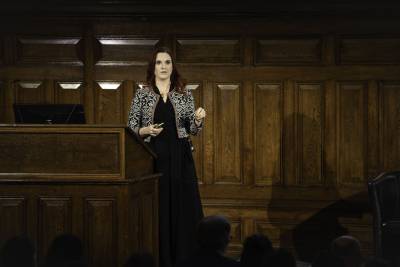
Speaking at Think AI for Government 2026, Philippa Evans, head of tariff and quota policy implementation at HMRC (pictured), explained that the existing service works well for experienced traders but can be overwhelming for newcomers.
“They come into our service and they get hit with a kitchen sink’s worth of data in the face, and they really don’t know how to do it,” she said.
Evans said the Online Trade Tariff, which has been available since 2012, has around 550,000 regular users, handles approximately 35 million searches through its interface annually and receives around 350 million API calls.
Starting with the problem
Jose Puyana, director of trade and growth at Transform, explained that the project grew out of several years of working with HMRC to improve the tariff service.
“We didn’t start with the question, how does AI fit here?” he said. “That was not the question. The question was a problem.”
Businesses could already access extensive information about customs requirements, but many needed more support to interpret it and understand what to do next. For smaller companies, mistakes can have serious consequences, including delayed shipments, unexpected costs and potentially lost customers.
Puyana said AI offered an opportunity to guide users through difficult decisions, beginning with commodity classification and potentially extending into areas such as customs valuation and rules of origin.
The work began with an eight-week AI lab, followed by 10 weeks of discovery before development and production. Puyana also stressed the importance of involving traders throughout the process, ensuring that the service reflected the difficulties businesses actually encountered.
Bringing together fragmented data
Developing the classification tool required HMRC to address longstanding problems with its underlying information. Evans explained that customs classification knowledge was spread across approximately 15 separate sources, with some expertise held by experienced staff rather than formally documented.
If you liked this content…
 Government urged to rethink public services as AI adoption accelerates
 Think AI for Government 2026: 8 key takeaways
 Government must test AI beyond the pilot to prove value
 From paperwork to prevention: How AI could change local government services
 Making AI work for government means looking beyond productivity
“We’ve had to get our classifiers and actually go through and start creating what’s basically an encyclopaedia,” she said.
This work involved bringing together existing information and capturing specialist knowledge that had previously been difficult for users, and sometimes colleagues, to access.
HMRC has also introduced an administration portal allowing customs experts to update the information used by the AI.
“We don’t let AI go wild. We control it,” said Evans.
The portal allows officials to add guidance, correct errors and link relevant commodity codes without depending entirely on developers to make changes.
Testing also revealed the importance of limiting what individual AI tools are asked to do. Evans said assistants covering too many topics could produce unreliable or irrelevant responses, whereas tools with clearly defined responsibilities performed more effectively.
From lookup tool to guided service
HMRC’s longer-term ambition is to transform the Online Trade Tariff from a service primarily designed for looking up information into one that guides users through customs processes.
One planned feature is an AI assistant that Evans calls a “concierge”, which would direct people to the appropriate part of the service. For example, someone wanting to send goods overseas could be guided towards commodity classification before moving through the relevant customs requirements.
“I would advise everybody to avoid the term chatbot with your customers,” said Evans.
Rather than attempting to answer every question itself, the proposed concierge would direct users towards specialist tools and authoritative guidance.
HMRC is also exploring more personalised services for frequent traders, including dashboards showing relevant commodity codes and alerts about changes to duties or controls.