Government departments should use AI to rethink how public services are delivered, rather than simply automating existing processes, speakers at Think AI for Government 2026 have said.
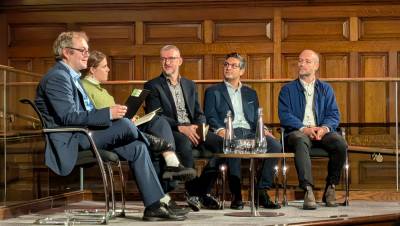
The discussion, which featured HM Revenue & Customs (HMRC), ElevenLabs, the Ada Lovelace Institute and the Ministry of Housing, Communities and Local Government (MHCLG) (pictured), explored how public bodies can prepare for rapid advances in AI while addressing concerns around regulation, sovereignty and public trust.
Nuala Polo, UK public policy lead at the Ada Lovelace Institute, questioned whether enough attention was being given to redesigning services around citizens’ needs.
“We’ve done a lot of research on how we want to envision public services rather than automating the services that we already have, which might not work for people, and making those things faster,” she said.
Giuseppe Sollazzo, deputy director in HMRC’s chief AI office, argued that established service design principles should continue to guide technology decisions.
“I would treat AI as every other technology, which is asking the GDS question to our users and what the user needs,” he said.
Sollazzo pointed to the limitations of transferring existing processes into digital formats, using online forms as an example of how technology can introduce unnecessary restrictions. He suggested AI could help organisations explore entirely different approaches to service delivery.
“We can use AI as a brainstorm to imagine new solutions, and that is a very powerful use of AI,” he said.
Chris Clark, deputy director of advanced analytics and AI at MHCLG, highlighted the importance of organisational adaptability.
“I think around future-proofing or thinking about the future, I think that the organisations that are most adaptable are probably going to adapt best,” he said.
Clark described work with local authorities to understand how AI can address service challenges, alongside the cultural and organisational changes needed to sustain its use.
Concerns over dependence on overseas AI
The panel also explored the risks of government’s growing reliance on AI models developed by overseas technology companies.
Polo said recent developments had prompted greater discussion about digital sovereignty and the potential consequences of depending on foreign suppliers.
“Government to be completely dependent on these models puts us in a really delicate place,” she said.
She questioned whether public bodies always needed the most advanced models, suggesting that smaller alternatives could be suitable for some government applications.
Elias David, head of UK&I at ElevenLabs, said data sovereignty was already a significant consideration for enterprise customers.
If you liked this content…
 HMRC using AI to make international trade easier for small businesses
 From paperwork to prevention: How AI could change local government services
 Think AI for Government 2026: 8 key takeaways
 Government must test AI beyond the pilot to prove value
 Making AI work for government means looking beyond productivity
“How do we ensure our data stays?” he said, describing one of the questions organisations were asking about AI deployments.
Public trust and AI regulation
Polo warned of a widening gap between public attitudes towards AI and the pace of government adoption. She said research by the Ada Lovelace Institute had identified demand for stronger safeguards, regulation and assurance that AI systems were safe to deploy.
Drawing comparisons with financial services, aviation and pharmaceuticals, she suggested government could learn from established regulatory mechanisms, including mandatory safety testing and routes for redress.
“There’s a lot of really common regulatory mechanisms that we don’t have for AI yet,” she said.
Polo also identified procurement as an area requiring greater expertise. Government teams purchasing AI systems may lack the technical knowledge to assess suppliers’ testing documentation or understand how performance could change after deployment.
“There’s a bit of a skill gap there in understanding what are the things we need to be asking for in order for these systems to be trusted over time,” she said.
Making AI more accessible
David highlighted opportunities for AI to improve accessibility and people’s interactions with technology. He described ElevenLabs’ work with government developers through hackathons, allowing frontline teams to explore practical applications of its voice technology.
“You are seeing those on the front line day-to-day solving real challenges using your platform or technology,” he said.
David also pointed to the company’s voice-restoration work, referencing Baroness Jane Campbell recently using an AI-generated voice in the UK Parliament during a House of Lords debate as an example of the technology’s potential to help people communicate.
He suggested such applications could help shift public perceptions towards the benefits of AI.
Preparing the workforce
Sollazzo stressed the importance of helping civil servants adapt their skills as AI develops.
“Part of the way we prepare for the future is to allow our people in our teams to evolve in their functions, in their skills,” he said.
He highlighted the increasingly multidisciplinary nature of AI, bringing together expertise in technology, policy, research and safety.
Clark raised the difficulties of procuring technology when requirements may change substantially within months.
“Technology is moving at such a fast pace that how can you even define what you want to buy today when it’s six months to a year from now that requirement will have just changed?” he said.
Practical experience, experimentation and a strong understanding of service users would remain important, he added.