AI could help councils move from responding to problems after they have escalated towards providing earlier support for vulnerable residents, according to speakers at Think AI for Government 2026.
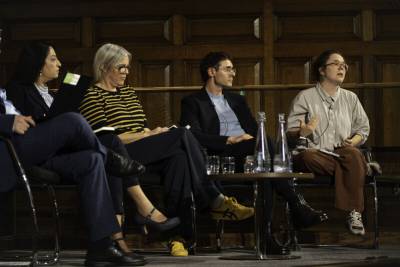
During a panel on AI in local government (pictured), representatives from Beam, North Yorkshire Council, the London Borough of Hackney and the Ministry of Housing, Communities and Local Government (MHCLG) discussed how the technology is already changing frontline services and what needs to happen next.
Seb Barker, co-founder and COO at Beam, which develops AI tools for local government and frontline public services, argued that councils were moving beyond the first phase of AI adoption, which largely focused on reducing admin work, towards tools capable of engaging directly with residents.
He described how Beam initially developed tech to help social workers produce statutory documents from recorded meetings, before expanding into live translation and AI voice agents.
“I feel we’re moving away from the first phase of AI, which was around document automation, maybe making current work a bit easier,” he said.
The next step, he suggested, was deploying AI agents safely and responsibly to help disadvantaged communities access better support at the right time.
From administration to earlier intervention
Barker described a recent example involving a council that used Beam’s AI voice technology to make nearly 2,000 calls in a day to people on a waiting list.
According to Barker, the council reached everyone on the list, including people who spoke different languages. Around 30 percent were redirected away from assessment, while some cases were resolved because individuals no longer required the service.
Barker, who previously worked with rough sleepers, said local government had long struggled to invest in preventative services because resources were consumed by the most complex cases.
“For as long as I’ve worked in or with local government, which is my entire career, we’ve always talked about prevention but never had the funding to do it,” he said.
He suggested that AI could help councils engage residents before their circumstances deteriorated, providing information about available services and communicating in their preferred language.
Tackling outdated processes
However, panellists cautioned that AI alone would not resolve the structural challenges facing councils.
Sabhia Malik, acting assistant director of ICT workplace systems at Hackney Council, said complex and outdated processes remained a major obstacle to adopting more advanced AI.
“The biggest blocker I’ve found to trying to think about agentic AI is the business processes,” she said.
Many council processes had evolved over years and involved multiple teams, making them difficult to automate effectively. Malik argued that councils needed to simplify how they worked before introducing AI.




“Otherwise, we’re just going to digitise…just some bad business processes,” she said.
Hackney has already introduced Google Gemini into its workplace tools and trialled Beam’s technology to reduce administrative work for social workers. Malik said reducing paperwork had enabled frontline staff to spend more time supporting vulnerable residents.
Cath Ritchie, head of AI strategy and innovation at North Yorkshire Council, similarly spoke of the importance of involving employees in deciding where AI could help. The council’s approach combines governance and assurance with conversations about staff concerns and practical experimentation.
Rather than starting with the technology, Ritchie said teams were encouraged to identify the parts of their jobs they found difficult or time-consuming.
Sharing what works
The discussion also highlighted the risk of councils developing similar AI solutions independently.
Louise Jakobsson, from MHCLG’s Local AI team, described work to support the development and reuse of AI tools across local government. This includes Local Transcribe, a transcription and summarisation tool being rolled out with council partners, alongside work on responsible AI guidance and improving access to data.
Jakobsson said councils were at very different stages of AI adoption, creating opportunities for more experienced organisations to share their learning.
“I think the opportunity is, what can we do jointly together, particularly around shared tools, common approaches, and knowledge sharing?” she said.
However, she cautioned against imposing centrally developed solutions that failed to reflect local circumstances, arguing that national initiatives should build on existing innovation rather than stifle it.
Barker argued that UK local government was already significantly ahead of other markets in its approach to AI.
“UK local government is an order of magnitude further ahead with AI than any other place we work in,” he said, referring to Beam’s experience in the US, Australia and Europe.
He said successful deployment depended on more than supplying technology. Beam provides training alongside engineering support to adapt tools to individual council teams and working practices.
Keeping services accessible
The panel also discussed the importance of ensuring AI did not deepen existing inequalities.
Malik highlighted Hackney’s socioeconomic diversity and the need to consider accessibility and digital exclusion when designing services.
“Any solution will have to incorporate the accessibility side of it, the digital inclusion side of it, and obviously the responsibility we have in terms of data,” she said.