Innovation in government needs to go beyond introducing new technology and focus on changing how departments work, make decisions and deliver services, according to speakers at Think Innovation for Government 2026.
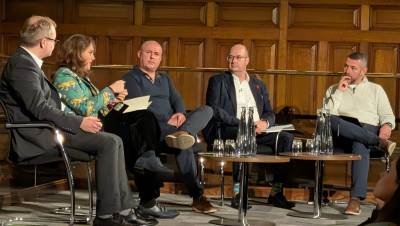
During a panel discussion on how innovation can support government priorities and civil service reform (pictured), representatives from the Disclosure and Barring Service (DBS), Home Office, government’s Incubator for Artificial Intelligence (iAI) and ElevenLabs discussed the cultural and organisational barriers preventing new ideas from delivering lasting improvements.
Gareth Bristo, associate director of innovation and emerging technology at DBS, argued that innovation was fundamentally about creating the conditions for change.
“Innovation isn’t all about technology. Technology is an enabler of innovation. Innovation is actually about creating the conditions to do things differently in organisations,” he said.
“Government priorities are better outcomes, better productivity, better public services. We won’t get there by doing the same thing faster and cheaper.”
Bristo said government needed to move away from a culture that instinctively rejected unfamiliar approaches towards one that encouraged people to explore their potential.
“New things carry risk, but standing still also carries risk. If things are changing around us, maintaining the status quo isn’t always the safe option.”
Moving beyond pilots
Mike Rudd, deputy director of science services and assurance at the Home Office, highlighted the difficulties of turning successful experiments into widely adopted services.
“Innovation gets siloed, and scaling that out of that little pocket of R&D funding is massively challenging,” he said.
He argued that existing funding and procurement arrangements could make it difficult for innovators to commercialise their work.
“You need a contract to scale, but you also need to scale to get a contract.”
As an example, Rudd pointed to body-worn cameras in policing, which he said took 15 years to move from initial pilots to adoption across police forces.
Matthew Hills, GTM lead for government and public sector UKI at ElevenLabs, questioned the value of running pilots without clearly defined objectives.
“When government departments come to me and say, ‘Hey, I would love to do a trial,’ I need to understand what the end goal is. Otherwise, it’s really a pointless trial to get up and running.”
If you liked this content…
 Think Innovation for Government 2026: 9 key takeaways
 Government must test AI beyond the pilot to prove value
 Government must use AI to reduce friction – not replace accountability, panel warns
 New tech, same old problems? Five takeaways from the civil service survey
 Government innovation under the spotlight at upcoming London conference
Elsewhere, Pippa Fernandes, deputy director of strategy and impact at the Incubator for Artificial Intelligence, agreed that innovation teams risked becoming isolated from the organisations they were intended to support.
“If you silo your innovation into teams like ours that sit under the system, you can have a tonne of innovation for innovation’s sake,” she said.
She explained that the incubator’s approach involved working alongside specialists within departments, including operational, product and procurement experts, to ensure successful innovations could be embedded into existing services.
Giving civil servants permission to innovate
The panel also considered how departments could encourage employees to develop ideas while managing the pressures of everyday service delivery.
Bristo described how DBS had established an innovation lab, inviting staff from across the organisation, regardless of grade, to contribute ideas. One example involved bringing together employees dealing with large volumes of casework data and colleagues experimenting with AI summarisation techniques.
The collaboration resulted in the development of a tool to summarise casework information.
“For me, it’s about recognising that you’ve got people in the business with great ideas, and not giving you the space to explore them,” he said.
Fernandes said it was the responsibility of leaders to give teams sufficient freedom to develop their own approaches.
“I think as leaders, like it is creating enough space for them to be able to run at particular problems, and also to have their back when they go to do something a little bit different,” she said.
However, Rudd acknowledged that repeated transformation initiatives had created fatigue among public sector employees.
“We’ve all got change fatigue. We’ve all got innovation fatigue,” he told delegates.
Rather than imposing further change, he suggested involving teams in identifying activities that could safely be stopped or redesigned.
The wider challenge, the panel agreed, was to make innovation part of how government operates rather than an additional activity carried out by specialist teams. That meant creating space for experimentation, supporting staff with new ideas and ensuring successful approaches could move beyond isolated projects into everyday public service delivery.