Innovation has moved firmly into the spotlight as the government looks to reform the civil service, improve productivity and deliver better public services.
This week, Cabinet Secretary Dame Antonia Romeo identified championing innovation and productivity as one of three central principles underpinning civil service reform.
Against this backdrop, Think Digital Partners’ Think Innovation for Government 2026 brought together 30 speakers from across central and local government, industry and the wider public sector to explore what innovation means in practice – and what is preventing promising ideas from delivering results.
Here are nine key takeaways from the day.
1. Government doesn’t have an innovation problem – it has a demand problem
Toni Peters, deputy director of commercial innovation at the Department for Business, Innovation, Science and Trade, challenged the assumption that procurement rules are the main obstacle to innovation.
“My first message is procurement isn’t the problem. It’s definitely a demand problem,” she said.
“What the Commercial Innovation Hub will tell you is this is a cultural problem, and it is a behavioural problem. People buy what they’ve always bought, and they buy it in the way they’ve always bought it, and that means they get the same outcomes they always got.”
Peters highlighted the newly launched Procurement of Innovation Playbook, designed to help public sector buyers define problems, engage suppliers earlier and create opportunities for innovative businesses to scale.
2. Public services need reinvention, not just optimisation
Eddie Copeland, director of the London Office of Technology and Innovation, argued that improving existing processes would not be enough to address the financial pressures facing local authorities.
He distinguished between optimising existing services and fundamentally redesigning them, particularly in adult and children’s social care, special educational needs and disabilities (SEND), and temporary accommodation.
“If we do not fundamentally reinvent those, we’re bankrupt. We need to pack up and go home,” he said.
Copeland argued that councils needed to think beyond “the tyranny of this financial year” rather than assume that adding AI to existing services would solve their problems.
3. Innovation must be designed to scale from the beginning
Across several sessions, speakers identified the difficulty of moving beyond pilots and experiments as a persistent challenge.
Jane Lucas, head of policy for local digital at the Ministry of Housing, Communities and Local Government (MHCLG), reflected on lessons from the Local Digital Fund.
“Innovation is not the problem. It is that scaling problem,” she said. “You need to think about scaling at the beginning, not really early on, not when you think that it’s a go. It needs to be considered right at the beginning.”
Mike Rudd, deputy director of science services and assurance at the Home Office, pointed to body-worn cameras in policing, which he said took 15 years to progress from initial pilots to adoption across police forces.
4. Innovation isn’t always about technology
A recurring message was that innovation should start with the problem rather than a particular technology.
Gareth Bristo, associate director of innovation and emerging technology at the Disclosure and Barring Service (DBS), said: “Innovation isn’t all about technology. Technology is an enabler of innovation. Innovation is actually about creating the conditions to do things differently in organisations.”
Meanwhile, Debbie Blanchard, head of profession for product management at the Department for Education (DfE), questioned government’s enthusiasm for AI.
“We’ve gone a little bit too far too fast in some areas with AI…We must have a shiny thing. Everything needs a shiny thing, which isn’t necessarily always going to make the difference you want it to make.”
If you liked this content…
 New tech, same old problems? Five takeaways from the civil service survey
 Government innovation under the spotlight at upcoming London conference
 DWP getting results with AI – but new report calls for stronger innovation culture
 Rethinking Innovation in Government
 Government seeks to drive more innovation in Civil Service
5. Better policymaking means involving people earlier
The conference’s first dedicated policymaking panel explored how government could move beyond traditional consultations towards more participatory approaches.
Camilla Pallesen, head of consultation and public participation at the Cabinet Office, described work to rethink how government engages citizens.
“We are looking at the shift away from box-ticking consultations to using a wide variety of participatory methods across government and beyond,” she said.
During the discussion, Sally Halls, head of the Policy and Innovation Lab at the Home Office, explained how her team brought user-centred approaches into policy development, helping policymakers understand problems before committing to solutions.
6. Innovation must work for everyone
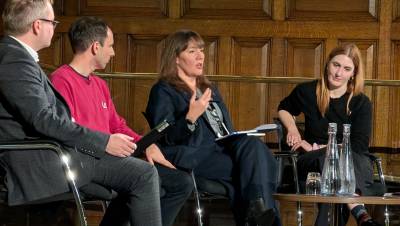
In a session on local digital innovation (pictured), speakers warned that innovation could not be considered successful if its benefits failed to reach people who were digitally excluded.
Tabitha Aldrich-Smith, associate director of communications and engagement at the Met Office, said: “Innovation is a process of making things better or doing things differently. But it doesn’t have to be by digital means either, especially for those who might be excluded from that.”
Polly Cziok, executive director of innovation and change at the London Borough of Merton, agreed.
“For me, innovation never starts with digital. It’s about where do we need to get to, and what do we want to achieve.”
7. More data doesn’t automatically mean better decisions
A discussion on data highlighted two challenges: accessing information held elsewhere in government and making sense of information organisations already possess.
Esther O’Sullivan, head of digital at the Agriculture and Horticulture Development Board, questioned why public bodies still faced obstacles when sharing data for service delivery.
Elsewhere, Jessica Figueras, CEO of CxB – Cyber Governance for Boards, warned that an abundance of information could be equally problematic. Describing lengthy cybersecurity reports presented to boards, she asked: “What the hell does it all mean?”
The challenge was ensuring decision makers understood what the figures represented and could critically assess their quality.
8. Innovation requires a different attitude to risk
Speakers repeatedly returned to the cultural barriers that discourage experimentation.
Bristo argued that government needed to become more comfortable testing new ideas, even when success was not guaranteed.
“New things carry risk, but standing still also carries risk. If things are changing around us, maintaining the status quo isn’t always the safe option.”
Laura Lucking, executive director of the infrastructure group at the National Audit Office (NAO), called for organisations to create “space where risk is managed rather than avoided”, while considering how innovations affect wider systems.
9. The future of innovation depends on turning ideas into lasting change
In the closing discussion, Euan Neill, head of innovation at the Home Office’s Accelerated Capability Environment, said demand was shifting away from simply demonstrating what new technology could achieve.
Instead, organisations increasingly wanted to understand how successful innovations could be incorporated into everyday operations.
Reflecting on the event, Think Digital Partners founder Matt Stanley, said: “As always, our speaker roster was second to none with 25 of our 30 brilliant speakers coming from across central and local government departments, across 10 engaging sessions with the affirming message that ‘Government doesn’t have an innovation problem it has a demand problem.’”