Government departments need to move beyond experimenting with AI and start rethinking how public services are designed and delivered if they are to realise the technology’s full potential, according to speakers at Think AI for Government 2026.
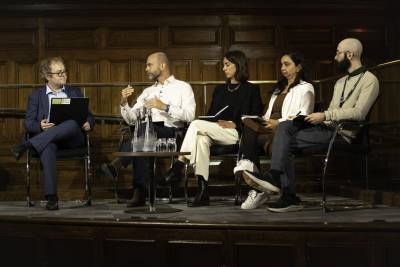
During a panel examining the future of AI in government (pictured), representatives from Sopra Steria, the Department for Education (DfE), the National Institute for Health and Care Excellence (NICE) and the Department of Science, Innovation and Technology (DSIT) discussed the challenges of scaling AI beyond individual pilots.
Neil Gladstone, data and AI practice director at Sopra Steria, argued that the technology is already capable of supporting significant improvements, but organisations must change how they approach its adoption.
“AI has moved beyond proving that the technology can actually work. It’s now about how we actually apply it to make sure we can deliver those really impactful services,” he said.
Rather than just automating existing processes, Gladstone said departments should consider how AI could help them redesign services around the outcomes they want to achieve.
“Stop treating it as a technology challenge,” he said.
Moving beyond pilots
Bridie Tooher, deputy director of digital delivery at DfE, described how her department had established two small teams to experiment with AI, including developing a tool to identify duplication and inconsistencies in guidance.
However, she acknowledged that turning these experiments into wider organisational improvements remained difficult.
“How do we actually scale stuff? I think we’re still learning that,” she said.
Tooher argued that responsibility for identifying and delivering AI opportunities should also sit with operational leaders rather than digital teams alone. At present, she explained, digital teams often manage lists of potential AI applications submitted by colleagues, even though many may not require AI at all.
“I think the business should own that and be holding us to account for delivering it,” she said.
She also suggested that organisations needed roles connecting digital specialists with operational teams to ensure productivity gains could be realised.
Gladstone agreed that multidisciplinary teams were essential.
“You simply cannot have a technical team that’s doing it,” he said, calling for smaller teams that bring together business and technology expertise.
Learning from experimentation
At NICE, associate director Raphael Sonabend-Friend described how testing AI had revealed opportunities to improve existing human processes.
If you liked this content…
 Beyond AI adoption: How government can turn technology into productivity gains
 Why successful AI transformation starts with people
 Government must test AI beyond the pilot to prove value
 From paperwork to prevention: How AI could change local government services
 Making AI work for government means looking beyond productivity
In one example, an AI model initially appeared unsuitable because it achieved 95 percent accuracy. However, subsequent testing found that people performing the same task achieved only 90 percent accuracy. The finding changed how staff viewed the technology and prompted a wider examination of existing working practices.
“We’ve actually redesigned our process, our human processes, from testing AI,” said Sonabend-Friend.
He argued that experimentation should help organisations understand how they work, rather than simply determine whether a particular technology is effective.
NICE has also introduced a process for assessing potential AI applications against factors including impact, risk and organisational readiness.
Sharing work across government
The panel also questioned whether departments were doing enough to share AI developments and avoid duplicating work. Tooher described discovering by chance that the Department for Business and Trade had developed a content-review tool that could potentially be useful elsewhere in government.
She suggested that central digital teams could play a stronger role in connecting departments and helping them reuse existing solutions.
Gladstone advocated communities of practice to share ideas, experiences and lessons learned.
“We’re guilty of inventing the same thing three or four times on occasion, and it’s absolutely the wrong thing to do,” he said.
He argued that sharing tools across several organisations could also strengthen the financial case for investment, particularly where individual departments had relatively small numbers of users.
Tooher raised similar concerns about the economics of building bespoke AI tools for hundreds rather than millions of users.
Putting people at the centre
For Gladstone, preparing government for AI also means ensuring staff understand what the technology can and cannot do. He described Sopra Steria’s internal approach of developing a vision of “hybrid intelligence”, in which AI supports employees rather than simply replacing them.
The aim, he explained, was to give staff confidence that AI could help them work more effectively and deliver better services.
“It’s about bringing people to the heart of it, being really human about what it is that you’re doing,” he said.
Tooher pointed to the Civil Service’s AI in Action training initiative, which involves practical workshops designed to improve understanding and confidence. At DfE, meanwhile, directors are being asked to work with AI champions to deliver the workshops across their divisions.
The panel agreed that leadership, training and organisational readiness would be as important as the technology itself.