Background
In November 2025, Thames Valley Police and Hampshire & Isle of Wight Constabulary became the first police forces in the UK to launch an AI-powered virtual assistant for non-emergency enquiries.
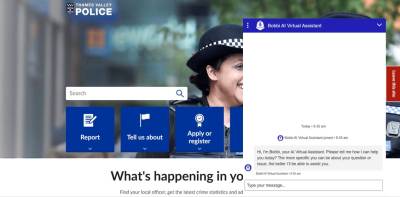
Known as Bobbi, the virtual assistant was developed to provide the public with another way to access policing advice and information online. Built on Agentforce, Salesforce’s agentic AI platform, Bobbi uses a secure, closed-source knowledge base containing information provided by the two forces.
It’s designed to answer routine questions, signpost users to the correct services and support existing contact channels, rather than replace them. Bobbi cannot be used to report crimes or emergencies, with users requiring urgent police assistance directed to existing emergency contact routes.
Challenge
The two forces wanted to improve public access to non-emergency policing services while managing growing demand on contact centres.
Their objectives were to:
- Provide a digital self-service option for routine enquiries
- Improve access to trusted policing information
- Reduce pressure on frontline contact centre teams
- Ensure more complex or vulnerable cases reached officers and staff more quickly
- Maintain public confidence through the use of a secure, closed-source ai platform
Solution
Bobbi was trained exclusively on information supplied by Thames Valley Police and Hampshire & Isle of Wight Constabulary, and was tested by more than 200 people, including members of independent scrutiny panels, victim support organisations and police staff.
The virtual assistant helps members of the public by answering frequently asked questions, providing crime prevention advice, explaining policing processes and directing users to the appropriate online services.
Where Bobbi identifies enquiries that require further support, users are directed to the appropriate policing channels.
The forces maintain that Bobbi is designed to complement existing services rather than replace human interaction, with appropriate safeguards built into the platform.
If you liked this content…
 Government’s £140 million investment signals new era of AI-enabled policing
 Salesforce pitches AI agents as answer to stretched public services
 NHS SBS and Salesforce launch AI platform to streamline NHS finance and procurement
 Data quality becomes a “core justice issue” in digital policing era
 Salesforce rolls out AI agents to UK public sector
“This is where AI can be a game-changer in the services that protect our communities,” said Mike Lattanzio, chief digital & information officer at Thames Valley Police. “By using AI responsibly, we’re making services more accessible and giving officers and staff better tools to deliver timely, informed responses.”
Results
Six months after launch, Bobbi has become an established part of the forces’ public contact offering, handling around 200 conversations every day and resolving approximately 45 percent of enquiries without human intervention.
One of the most significant outcomes has been Bobbi’s ability to engage people who may not otherwise have contacted the police. The virtual assistant provides a discreet, 24-hour digital channel where members of the public can ask questions, seek advice or raise concerns without needing to make a phone call. It also supports multiple languages, helping improve accessibility for diverse communities.
According to Thames Valley Police, this has contributed to Bobbi identifying an average of one high-harm offence requiring immediate escalation every day since launch, as well as around two cases involving violence against women and girls each day.
The force also reports that Bobbi has:
- Achieved a public satisfaction rating of 4.6 out of 5
- Freed more than 3,200 operational hours annually
- Supported the equivalent of around 14,000 citizen contacts each year
“This is a pioneering moment in policing,” said chief superintendent Simon Dodds from the Joint Operations Unit for Thames Valley Police and Hampshire & Isle of Wight Constabulary. “Bobbi has allowed us to rethink how we manage non-emergency demand, ensuring our officers and staff can focus on the people and situations that need them most.”
Next steps
Thames Valley Police and Hampshire & Isle of Wight Constabulary will continue to develop Bobbi as part of their wider digital transformation programmes.
The forces say the virtual assistant will continue to evolve while remaining focused on improving access to policing services, supporting contact centre teams and ensuring members of the public can quickly access trusted information and the most appropriate route for assistance.