
Government organisations should measure the success of their data strategies by the outcomes they deliver rather than the technology they deploy, according to Shaun Russell, enterprise architect at Aker Systems.
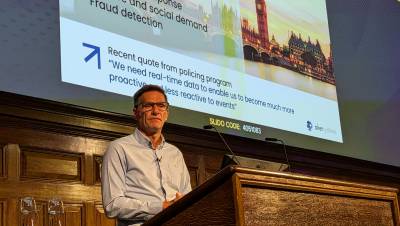
Speaking at Think Data for Government 2026, Russell (pictured) argued that real-time data streaming gives public sector organisations the opportunity to respond to events as they happen, but said the real value lies in improving services, supporting better decisions and making more effective use of public resources.
“Ultimately, technology only matters if it improves the services and the decisions we make,” he said.
Russell focused on five organisational outcomes that he believes real-time data can help government achieve.
Improving citizen services
The first is better citizen services.
Russell said government organisations are under increasing pressure to deliver responsive digital services and that access to operational data provides visibility into demand, service performance and emerging issues.
“This allows resources to be adjusted quickly, bottlenecks to be identified earlier, and services to become more responsive to citizens’ needs,” he said. “The outcome is shorter waiting times, improved service delivery, and a better citizen experience.”
Earlier intervention
The second outcome is earlier intervention and risk reduction.
Russell argued that many government challenges become more expensive and more difficult to address the longer they remain undetected, whether they involve safeguarding concerns, operational disruption, environmental risks or compliance issues.
“The ability to identify signals early creates opportunity for early intervention,” he said.
“The outcome is not simply faster awareness; it’s preventing small issues from becoming larger and more costly problems.”
Making better use of resources
Russell said real-time operational insight can also help organisations deploy finite public resources more effectively.
“Every organisation faces the challenge of balancing demand with finite resources,” he said. “Real-time operational insight enables leaders to understand changing conditions as they happen and make more informed decisions about where resources should be deployed.”
He said the outcome is “greater efficiency, improved productivity, and better value for money.”
Joining up government
Russell also highlighted the potential for improved collaboration across government.
“Many citizen journeys span multiple departments, agencies and systems,” he said. “Too often, information is fragmented and disjointed across organisational boundaries, limiting visibility and coordination.”
Real-time data sharing, he argued, enables organisations to develop a more connected view of operations and respond collectively rather than independently.
“The outcome is better coordination, reduced duplication, and more joined-up service delivery.”
Better decisions depend on trusted data
Russell said every operational, tactical and strategic decision depends on the information available at the time.
“By reducing the delay between events occurring and insights being generated, decision-makers gain a more accurate and timely understanding of what is happening across the organisation,” he said. “The outcome is greater confidence, improved responsiveness, and more informed decisions.”
If you liked this content…
 Real-Time in Government
 Data modernisation for government: from legacy data to data products
 Think Data for Government 2026: Public sector must prepare data for the AI era
 Think Data for Government 2026: Government’s data sharing challenge is now cultural rather than technical
 Think Data for Government 2026: 10 key takeaways
However, he warned that faster access to data only creates value if the information itself can be trusted.
“If poor quality data is streamed faster, we simply make poor decisions faster,” he said.
For that reason, strong governance remains essential.
“We need clear ownership of data, agreed standards, robust security controls, and confidence in the quality of the information being used.”
Russell also said trust becomes increasingly important as analytics and AI play a greater role in supporting decisions.
“We must be able to explain how those decisions were reached. Transparency, auditability and accountability are critical to maintaining public confidence.”
He added: “Technology should enhance decision making, not remove human responsibility.”
Technology is only part of the answer
Drawing on Aker Systems’ experience delivering streaming and real-time data capabilities across multiple use cases, Russell said successful programmes require far more than implementing new technology.
“Successful streaming initiatives start with business outcomes, not technology,” he said. “The most effective programmes begin by identifying where faster access to information can genuinely improve decision making, service delivery and operational efficiency.”
Delivering those capabilities requires expertise in architecture, engineering and data governance, alongside people who understand how to connect technology with operational outcomes.
“Many of the challenges are not purely technical,” Russell said, pointing instead to organisational change, cross-team collaboration, security, compliance and long-term sustainability.
“The result is not a new technology platform. It’s the creation of a modern data capability that enables organisations to operate with greater awareness, respond with greater agility, and make decisions with greater confidence.”
Measuring success by outcomes
Closing the session, Russell returned to what he described as the central theme of his presentation.
“This is not a technology story, it’s a data story, and more importantly, it’s an outcome story,” he said.
Government organisations already possess vast amounts of data, he argued. The opportunity is to use it more effectively by moving information across organisational boundaries, identifying events as they happen and ensuring insights reach the people and systems able to take action.
He argued that success should not be measured by the amount of data processed or the sophistication of the technology.
“Success is measured by actions,” he said. “Are our citizens receiving a better service? Are our operational teams able to respond more effectively? Are risks being identified earlier? Are resources being allocated more effectively? And are we making decisions with greater confidence because they are based on timely, trusted information?”
Russell said achieving those outcomes depends on governance, trusted data and responsible use of information.
“When those foundations are in place, data streaming becomes far more than a technical capability. It becomes an organisational capability… because the goal is not real-time data. The goal is always about achieving real-time outcomes.”


