Government teams must start treating accessibility and digital inclusion as fundamental design responsibilities that affect everyone, according to speakers at Think Digital Government this week.
During a panel discussion on making digital and data work for everyone, an expert panel argued that public services cannot genuinely be “digital by default” unless they are inclusive by design from the outset.
The conversation explored how exclusion continues to emerge through access barriers, assumptions in service design, inaccessible interfaces and narrow definitions of accessibility itself. Speakers also warned that organisations often continue prioritising the needs of the easiest-to-reach users while overlooking broader social responsibilities.
Freddie Quek, chair of the BCS Digital Divide Specialist Group, argued that digital inclusion must be viewed through a different lens in the public sector than in commercial environments.
“The private sector is about ‘we just care only about the ones that make sense, because it’s commercially viable.’ But from a public sector lens, you need to solve the problem for everybody,” he said.
Quek said the tech industry has historically approached accessibility as a niche requirement rather than a universal design principle.
“Many of us are doing something called accessibility features. But what we should be thinking… is accessibility for all,” he noted.
He also warned that accessibility should not be seen just as a response to permanent disabilities, but as something relevant to everyone at different points in life.
“All of us today, we are in good healthy state of mind and body. But all of us are also humans, that the point will come either temporarily, situationally, or permanently, we will not be able to.
“We’re making incredibly powerful decisions”
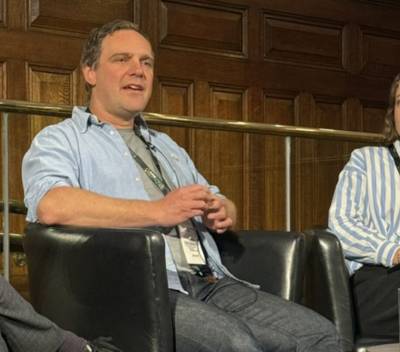
Joe Thompson, CTO at digital consultancy Hedgehog Lab (pictured), said digital services and platforms increasingly shape how society functions in ways many organisations fail to fully appreciate.
Reflecting on years spent building digital products, Thompson compared modern digital infrastructure to the canals, railways and engineering systems that transformed society during previous centuries.
“I think a lot of the technology infrastructure that we build every day has these incredibly profound implications for how people interact with each other, how they interact with the state,” he said.
He warned that when organisations ignore certain users or use cases because they are inconvenient or commercially unattractive, they are effectively deciding who digital society is designed for.
“If we ignore certain classes of users… because they’re not convenient for us now, we’re actually making incredibly powerful decisions that I’m not sure we’re equipped to make,” he said.
If you liked this content…
 Why people-powered UX means good public services
 Why ‘digital first’ shouldn’t mean public services go digital only
 In the spotlight: Coventry City Council improves access to planning data through digital transformation
 One Login could cover every central government service within 18 months, says GDS
 MHCLG develops AI Gateway to simplify secure AI adoption across digital services
For Thompson, inclusion is closely tied to digital ethics and to ensuring public services genuinely feel available to everyone.
“I always think of inclusion as it means making sure that everyone feels that your product or service is for them,” he said.
Building the conditions for inclusive design
Jessica Riley, head of user-centred design at the Ministry of Housing, Communities and Local Government, focused on how organisations can create the conditions for inclusive thinking to happen consistently across teams and programmes.
Riley argued that organisations need cultures where people feel comfortable questioning assumptions and admitting uncertainty.
“It’s really about having the conversation at that point about what are our assumptions, what do we know, what don’t we know, what don’t we know we don’t know,” she said.
She said inclusive design must begin at the earliest stages of projects rather than being treated as a late-stage testing exercise.
“It’s not about at the end of an alpha phase saying we’re testing this thing. It’s saying when we do the research… we’re making sure we’re including the right people.”
Riley highlighted empathy mapping workshops as one technique for helping teams understand the lived experiences and assumptions affecting different groups of users.
She also pointed to the growing use of accessibility labs within organisations, allowing teams to test products and services using different accessibility tools and user scenarios.
The risks of designing only for the “easy” users
The panel also discussed the tension between commercial efficiency and universal accessibility. Thompson argued that many organisations still implicitly design for the majority while excluding more complex or less profitable user groups.
“Why are we choosing not to make them better for that 20 percent?” he asked.
He said digital inclusion discussions often wrongly assume there was once a perfect non-digital alternative that worked for everyone.
“There are things we can do with digital that are wildly efficient, but they’re also so much better for people.”
He pointed to AI-enabled voice services as one example of technology that could make services significantly more accessible for some users while also improving efficiency.
“There’s a lot of these things that if you reframe the question you actually answer it yourselves,” he said.