A new supercomputer will enable the Met Office to provide with better forecasts, alongside helping scientists advance climate research around the world.
While the Met Office has almost always run its own supercomputers on site before now, the new cloud-based system runs on Microsoft Azure.
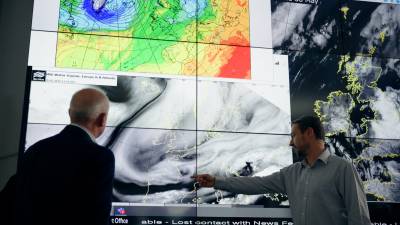
The Met Office’s CIO, Charles Ewen, has overseen the project to shift computing to the cloud.
“We use a technique to predict the future state of the atmosphere called numerical weather prediction,” he said. “So that takes the laws of physics that are fairly well understood and applies them at scale to observations of the current state of the atmosphere. To do that is very, very computationally expensive. It’s simulating the future state of the atmosphere. Operationally, that’s 200 to 300 terabytes of information a day.”
The new supercomputer is giving the Met Office a variety of advantages, Ewen said, including better forecasts over longer time periods.
“People ask how a bigger computer improves the weather forecast,” he said. “One big thing this new computer will allow us to do in the near future is to be able to produce 14-day forecasts with a similar kind of accuracy than we can today for seven, eight, nine days.”
If you liked this content…



Beyond that, he said the meteorologists and researchers at the Met Office are always hungry for more computing power, to run more complex weather models to gather and analyse more data.
Ewen said that one of the advantages of working in Azure is that expanding capacities for specific research projects can be done on a case-by-case basis – meaning the Met Office can take on new projects without having to build new infrastructure.
“We don’t know yet how our CPU-based supercomputer services will be augmented with machine learning,” he said. “A lot of research is being done at the Met Office and elsewhere to find out.”
With Microsoft, he said, “We’ve got the flexibility to make those choices and make sure we’re well equipped with the right tools for the right jobs at the right times.”
Additionally, Ewen said that the Met Office is investing in the future of AI and machine learning with training programmes and the funding of advanced degrees for some of its researchers.
“We’re already in the game, preparing our people,” he said. “We’ve put more than 100 people through a foundational machine-learning program, plus we have put around 20 people through a formal master’s program. These people are already experts in another field, like atmospheric physics.”