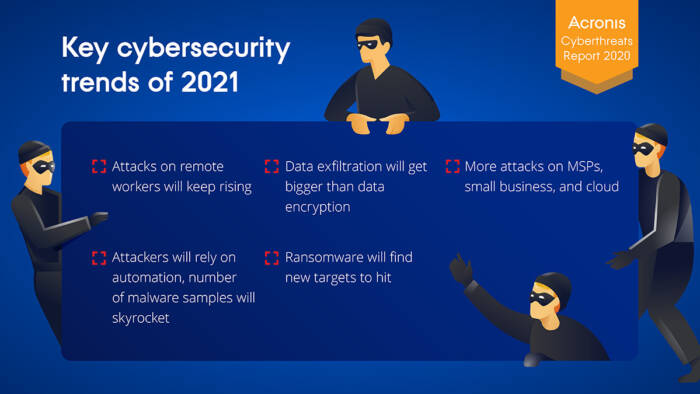
2021 will bring aggressive cybercrime activity as criminals pivot their attacks from data encryption to data exfiltration.
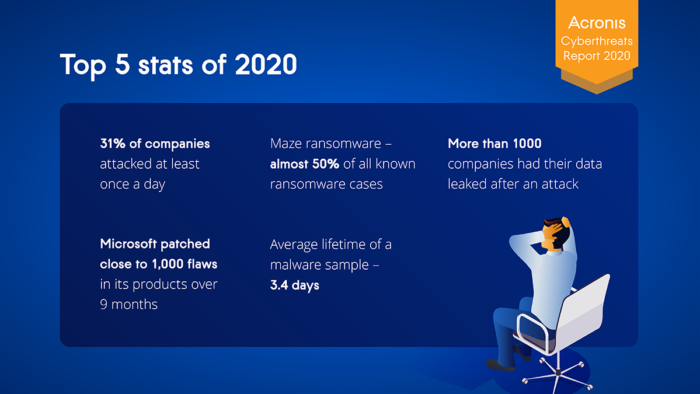
That’s according to a new report by the 2020 Acronis Cyberthreats Report, which highlights the rise in ransomware attacks. Acronis reports that more than 1,000 companies had their data leaked following a ransomware attack in 2020 – a trend that is expected to accelerate in the coming year, overtaking encryption as the criminals’ primary tactic.
Not content to collect ransoms to decrypt infected data, criminals are now stealing data before encrypting it. They then threaten to publicly release the stolen files if the victim doesn’t pay up.
“More than any year in recent memory, 2020 posed a tremendous number of challenges to IT professionals, organisations, and the service providers who support them,” said Stas Protassov, Acronis co-founder and technology president.
“What we’ve seen is how quickly bad actors are adjusting their attacks to the new IT landscape. By analysing the activity, attacks, and trends we’ve detected and clearly presenting our findings, we hope to empower our partners and help the IT community at large prepare for the threats on the horizon.”
Local government bodies were identified as the most likely target for ransomware attacks, according to separate research from August. Forty-four percent of all observed ransomware attacks in 2020 aimed at municipalities.
If you liked this content…





Among the other notable findings in the Acronis Cyberthreats Report include:
Attacks against remote workers will increase
While 31 percent of global companies reported daily cyberattacks in 2020, the frequency of attacks targeting their remote workers is projected to increase in 2021, since the defences for systems outside of the corporate network are more easily compromised, giving bad actors access to that organisation’s data.
Ransomware will look for new victims, become more automated
Rather than continuing to cast a wide net, ransomware attackers will focus on targets that provide a bigger return on their efforts. Breaking into one network to steal data from several companies is more profitable than attacking individual organisations. So, while small businesses will still be targeted, cloud environments and organisations like managed service providers will become more valued targetsbecause their systems can provide access to the data of multiple clients.
Legacy solutions struggle to keep up
Blocking the new malware has rendered traditional antimalware solutions obsolete, as they cannot keep pace with the increased sophistication and frequency of new threats. The average lifespan of a malware sample in 2020 was just 3.4 days. As attackers continue to utilise automation, the number of malware samples will continue to climb. Organisations will need to find new approaches to protection that are agile and designed to stay ahead of new threats. Simple standalone security and backup solutions will no longer be enough.
“When it comes to existing solutions and strategies, the current trends in cyberattacks all show that traditional cybersecurity is failing – usually because of weak technologies and human error, which are both avoidable,” said Candid Wüest. the VP of Cyber Protection Research at Acronis and co-author of the report.
“Just as cybercriminals are evolving their attacks, organisations need to advance their protection and security. Comprehensive cyber protection solutions offer the integration and automation that eliminate complexity, optimise performance, and streamline recovery when a successful attack inevitably occurs.”