GOV.UK One Login is likely to provide access to every central government service within the next 18 months, according to Natalie Jones, director for One Login and verified credentials at the Government Digital Service (GDS).

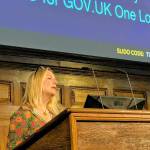
Giving an update on the programme at Think Digital Identity and Cyber Security for Government, Jones (pictured) said One Login has now reached 256 services and more than 23 million users.
“Within the next 18 months, it’s not just possible; it’s actually probable that people will use One Login to access every single central government service,” she said. “So the rhetoric will have become the reality.”
The update comes as GDS continues the migration of HMRC services to One Login and prepares for the national rollout of the digital driving licence. HMRC entered public beta with One Login in February, following what Jones described as three years of work between GDS and the department.
New HMRC users are now using One Login, but Jones said this represents only the first stage of a three-phase integration. The next stage will involve migrating existing Government Gateway users, followed by people who use HMRC services professionally as part of their jobs.
Digital driving licence targeted for spring
GDS is also preparing for a wider rollout of the digital driving licence through the GOV.UK Wallet.
Jones said the government plans to open its sandbox to private sector digital identity service providers next month, before carrying out end-to-end testing with real users, driving licences and providers at the end of the year.
“From spring next year, we hope to be starting a national public rollout,” she said.
The driving licence forms part of a much wider ambition to digitise government-issued proofs and entitlements.
During a Q&A, Jones said GDS has identified around 80 credentials that could eventually be made available digitally, including passports, birth certificates, proof of benefits, DBS checks and fishing licences.
“The digital blueprint includes a commitment to do all proofs and documents,” she said. “Name a thing the government sends you that you then use somewhere else. That will be a verified credential.”
Moving beyond digital versions of documents
Jones stressed that the wallet programme is not just about reproducing physical documents on a smartphone. Verified credentials could allow organisations to check information directly from an authoritative source, rather than relying on someone to assess whether a physical document is genuine.
They could also allow users to share only the information required for a particular transaction. Someone proving their age, for example, would not necessarily need to disclose their full name, address or driving history.
Jones said this could ultimately change interactions ranging from collecting prescriptions and parcels to proving eligibility for benefits or age-restricted purchases.
“The digital driving licence isn’t simply a driving licence on a phone,” she said. “It’s the first widely recognised example of a different way for people, government and businesses to establish trust.”
If you liked this content…
 Post Office to offer in-person help for GOV.UK One Login users
 Passkeys rolled out to 23 million GOV.UK One Login users
 Tech leaders warn against dismantling UK digital leadership as Burnham eyes Whitehall overhaul
 Government eyes full adoption of GOV.UK One Login by 2027
 Scottish digital identity programme to be extended
The GOV.UK Wallet already contains the digital veterans card, which became its first government-issued digital credential last October.
New ways to prove identity
GDS is meanwhile expanding the ways users can prove their identity through One Login.
Jones said work with the Department for Work and Pensions has introduced a new knowledge-based verification route using information already held by DWP.
Previous knowledge-based verification questions relied on an individual’s financial footprint, potentially creating difficulties for people with little or no credit history. According to Jones, early results show that nearly twice as many people successfully complete the new DWP-based module as the previous version.
GDS has also introduced passkeys for One Login. Around 300,000 people chose to use them during the first month, with GDS expecting passkeys to halve sign-in times as well as make accounts less vulnerable to phishing and other cyberattacks.
Jones said open banking will also be introduced as another route for identity verification.
GDS recently awarded open banking technology provider Ecospend a £4.7 million contract to support identity verification, identity validation and fraud risk assessment for One Login. The new route, expected to roll out in 2027, will allow users to choose to share information held by their bank to help prove their identity.
The move is intended to provide an additional verification option alongside routes using documents such as passports and driving licences.
Digital inclusion remains part of the programme
Asked how One Login would work for people who do not want or are unable to use digital services, Jones said government services would continue to require alternative routes.
“There are exception processes for all the services we work with, and we maintain a sort of canonical list of those things to make sure that they get appropriate investment as well,” she said.
The aim, she added, was to ensure people for whom interacting online was not the right option still had “a decent channel that doesn’t rely on it”.
Jones said the growth of One Login over the past year showed the programme was moving beyond its earlier promise.
“12 months ago, GOV.UK One Login was a platform with potential,” she said. “Today, 23 million people use it. There are 256 services on it.”
The next stage will require government, industry and other partners to make the wallet and verified credentials work across public services and the wider economy, she added.
“Trust won’t be won by an announcement, a strategy, or a clever demonstration. It will be won when the person collecting the prescription, applying for a job, buying an age-restricted product, or accessing a public service finds that the new way is simply better than the old way.”